TIPSS Procedure in Bangalore – Minimally Invasive Treatment for Portal Hypertension
Image-Guided TIPSS (Transjugular Intrahepatic Portosystemic Shunt) for Advanced Liver Disease
Advanced liver disease can lead to difficult complications such as abdominal / pleural fluid accumulation (ascites / effusion), internal bleeding, and repeated hospital visits. While liver transplant is often considered in severe cases, many patients can be effectively managed with a minimally invasive procedure called TIPSS (Transjugular Intrahepatic Portosystemic Shunt). Every hospitalisation can further worsen overall liver health.
At Pinhole Clinic in Bangalore, Dr. Rohit Madhurkar and his team specialise in performing TIPSS procedures using advanced image-guided techniques. This approach helps reduce portal pressure, control complications, and improve quality of life — without the need for open surgery. The procedures are usually performed at Apollo Hospitals with state-of-the-art support and equipment.
Understand in Simple Words
Like how Dr. Rohit Madhurkar explains it to patients:
Normal Liver
Think of your liver like a soft sponge. When we pour water on it, the sponge absorbs it, and once full, the excess flows out smoothly.
Here, blood comes from your intestines carrying nutrients from the food you eat, through the portal vein into the liver. This blood is in a “raw” form. The liver processes it — like a filter and factory — converts it into a usable form, and then sends it to the heart through the hepatic vein.
This is how normal metabolism happens smoothly.
Cirrhotic Liver
When the liver becomes cirrhotic, it is no longer soft like a sponge. It becomes hard — more like a brick. When you pour water on a brick, it only gets wet and the water spills away.
Blood still tries to flow into the liver through the portal vein, but because the liver is stiff, it cannot handle the flow properly. Some blood passes, but much of it gets blocked or backed up.
Because of this:
- Pressure builds up in the portal vein (portal hypertension)
- Fluid starts leaking into the abdomen (ascites)
- Fluid may collect in the chest (pleural effusion)
- Blood vessels in the food pipe become swollen and can bleed (variceal bleeding)
What We Do in TIPSS (TIPS Procedure)
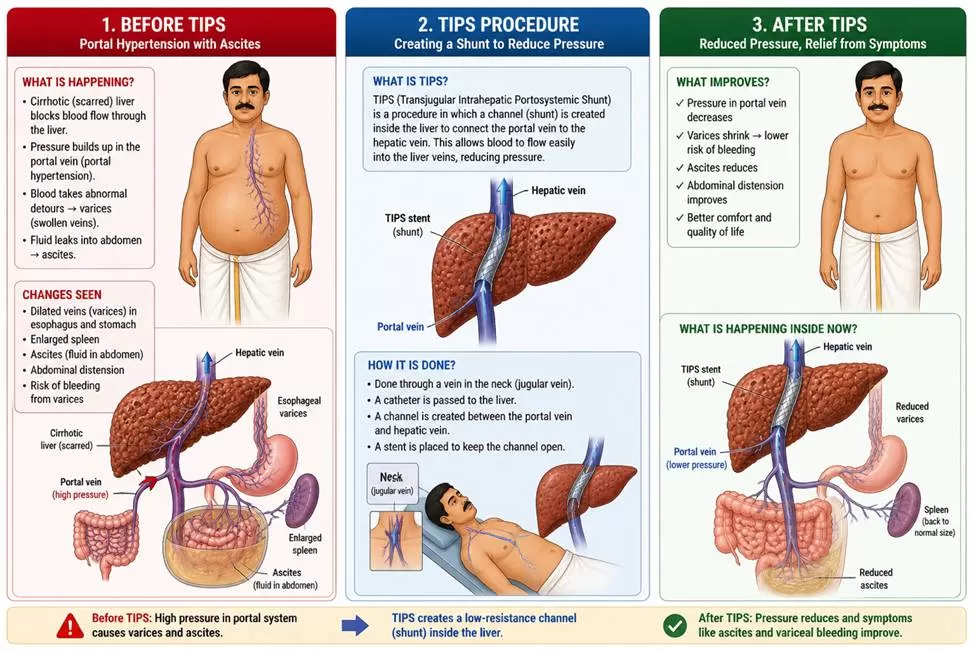
In simple terms, we create a bypass inside the liver.
We connect the portal vein (high-pressure side) directly to the hepatic vein (low-pressure side). Instead of forcing blood through the stiff liver, we create a new pathway.
The blood then flows more freely toward the heart.
Because of this:
- Pressure in the portal vein decreases
- Fluid accumulation reduces
- Risk of bleeding decreases
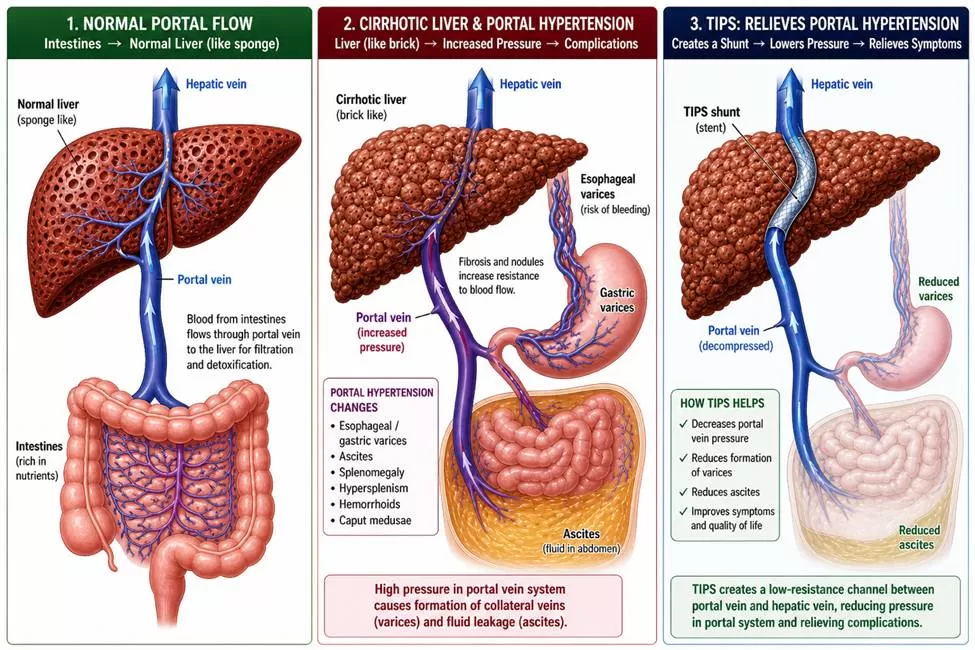
TIPSS is like creating a pressure-release pathway inside the liver to prevent complications by bypassing the hardened liver.
The TIPSS shunt procedure in Bangalore is a marvel of modern interventional radiology. This artificial tunnel allows blood to bypass scarred tissue, immediately relieving dangerous pressure buildup.
During the procedure, a stent is placed to connect the portal vein to the hepatic vein. This allows blood to bypass scarred liver tissue, reducing pressure almost immediately and preventing further complications.
When is TIPSS Recommended?
TIPSS is usually advised for patients who are not responding adequately to medical treatment:
- Refractory ascites requiring frequent fluid removal
- Recurrent variceal bleeding despite endoscopic treatment
- Complications of portal hypertension such as hydrothorax or portal gastropathy
- Stabilisation in patients awaiting liver transplant
- Emergency (salvage) TIPSS in acute massive bleeding
Conditions Treated
Portal Hypertension / Portal Vein Thrombosis
TIPSS lowers the pressure in the portal vein and helps control complications caused by liver cirrhosis.
Chronic Ascites Treatment
TIPSS acts as a long-term internal solution for patients with recurrent abdominal fluid accumulation.
Variceal Bleeding Treatment
TIPSS reduces pressure in swollen veins and prevents life-threatening internal bleeding episodes.
Liver Cirrhosis Complications
TIPSS may also help manage hepatorenal syndrome and hydrothorax, improving quality of life.
How the TIPSS Procedure Works
- The Pinhole Entry – A tiny puncture is made in the neck to access the jugular vein.
- Navigation – Using real-time X-ray guidance, a catheter is guided to the liver.
- Creating the Path – A pathway is created through the liver tissue, connecting the portal vein and hepatic vein.
- Stent Placement – A metal mesh tube (stent) is placed to keep the pathway open permanently.
- Pressure Check – Pressure levels are measured to ensure they are reduced safely.
The procedure usually takes around 60 to 90 minutes.
Benefits of the TIPSS Procedure
- No abdominal cutting
- Minimal blood loss
- Rapid stabilisation of portal pressure
- Life-saving intervention in critical cases
- Shorter hospitalisation compared to open surgery
Recovery After TIPSS
Recovery is generally smooth, and most patients stay in the hospital for 2 to 3 days for monitoring.
- Immediate Post-Procedure – Patients are monitored in the ICU to ensure the stent is functioning properly.
- At Home – Most patients notice reduced abdominal swelling within 2 to 3 weeks.
- Long-Term Care – Doppler ultrasound scans are scheduled regularly to monitor the stent.
Some patients may develop hepatic encephalopathy (confusion due to altered blood flow), which is usually manageable with medications such as lactulose.
Why Choose Pinhole for TIPSS in Bangalore?
Pinhole Clinic is a specialised centre for interventional radiology liver treatment, led by Dr. Rohit Madhurkar and team. Procedures are performed at Apollo Hospitals with advanced support systems.
We combine compassionate patient care with advanced imaging technology and multidisciplinary expertise:
- Advanced interventional radiology expertise
- Precision imaging technology
- Multidisciplinary hepatology & gastro support
- Strong experience in portal hypertension management
- Capability to handle complex procedures
Patient Outcome Examples
A 64-year-old businessman requiring repeated fluid removal underwent TIPSS and experienced a significant reduction in fluid accumulation, avoiding repeated hospital visits and improving his daily quality of life.
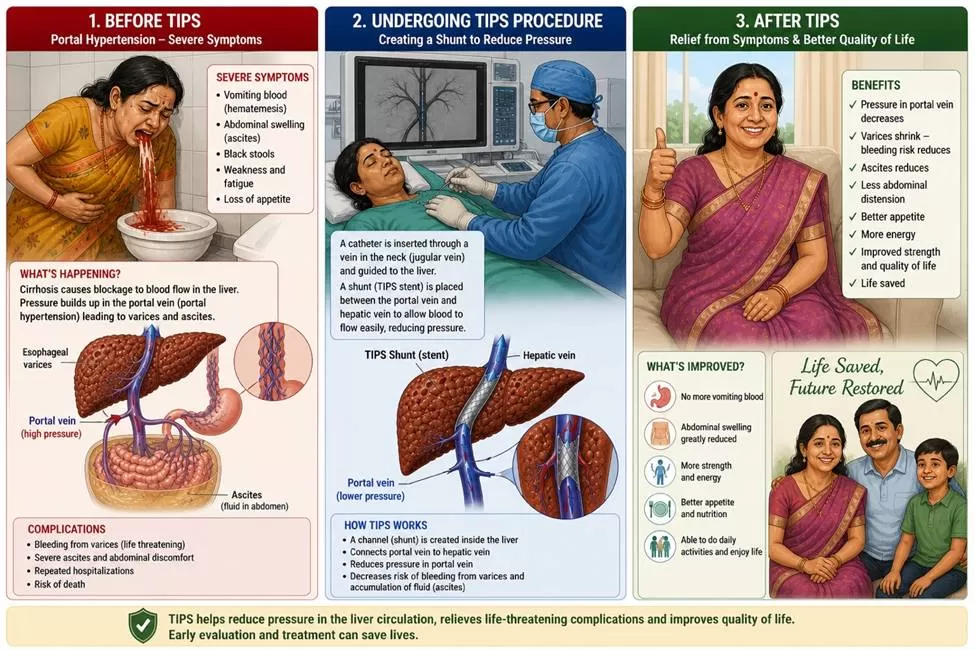
A 46-year-old woman with repeated blood vomiting underwent TIPSS, which successfully controlled bleeding and reduced the possibility of future episodes by more than 90%, eventually bridging her safely to liver transplant.